
About the Journal
International Journal of Emerging Engineering and Technology (IJEET) is a peer-reviewed, scientific and technical journal owned and published by the Swedish College of Engineering and Technology, Rahim Yar Khan, Pakistan. IJEET publishes high-quality original scientific articles dealing with the use of analytic and quantitative tools for the modelling, analysis, design and engineering management in the engineering and technology disciplines.
Current Issue
Vol. 5 No. 1-2 (2026): Emerging Trends in Artificial Intelligence, Multidisciplinary Engineering, Health and Smart Technologies
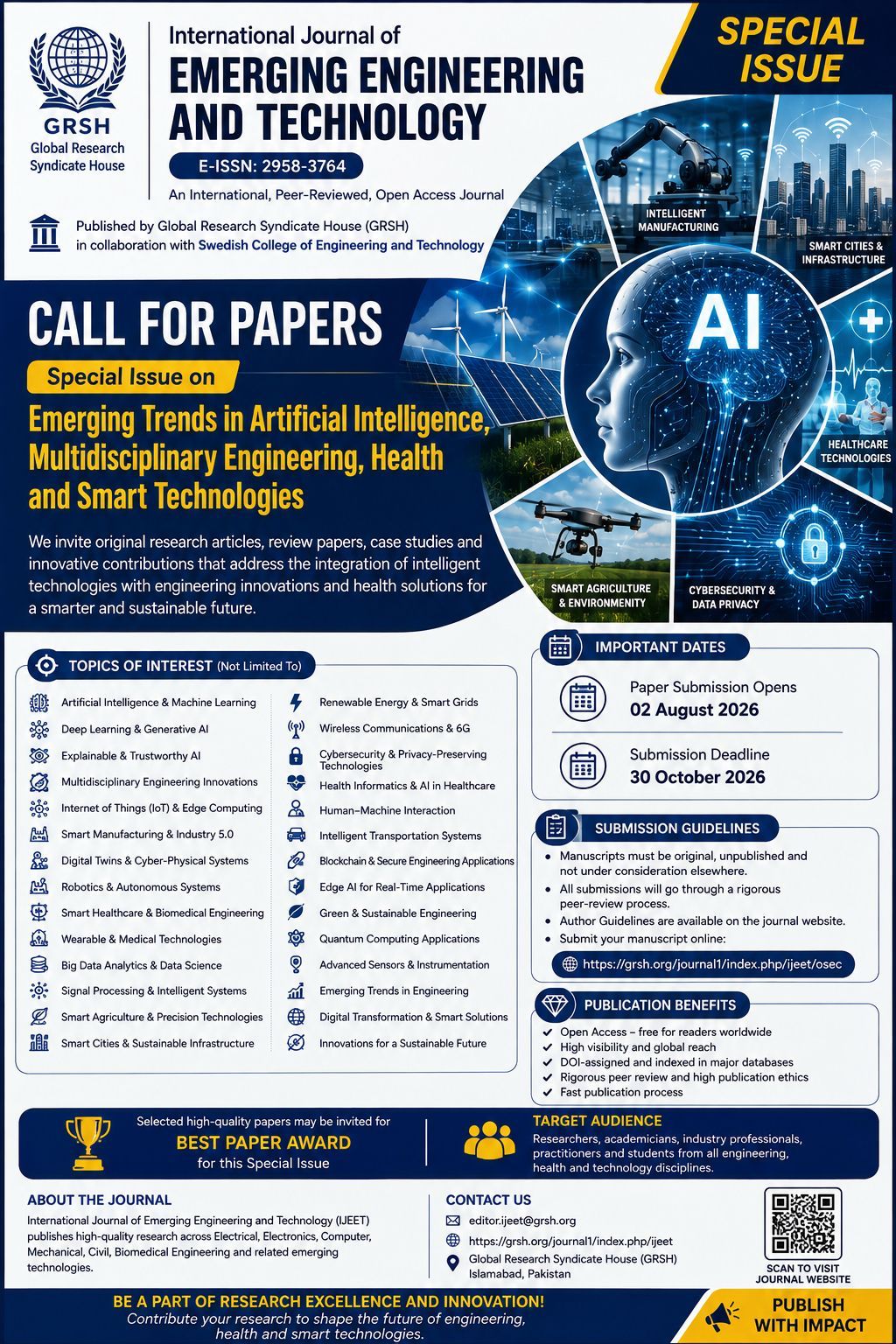
The rapid evolution of artificial intelligence (AI), intelligent computing, and emerging engineering technologies is fundamentally transforming modern industries, scientific research, and societal development. Recent advances in machine learning, deep learning, edge intelligence, digital twins, the Internet of Things (IoT), cyber-physical systems, robotics, quantum computing, blockchain, and next-generation communication networks are enabling unprecedented levels of automation, efficiency, resilience, and sustainability across diverse engineering domains. These technological breakthroughs are accelerating the transition toward Industry 5.0, smart manufacturing, intelligent healthcare, sustainable energy systems, autonomous transportation, smart cities, and data-driven decision-making.
This Special Issue aims to provide an international platform for researchers, academicians, engineers, and industry practitioners to present cutting-edge theoretical developments, innovative methodologies, practical applications, and interdisciplinary research addressing current and future challenges in emerging engineering and technology. The issue welcomes original research articles, comprehensive review papers, industrial case studies, and application-oriented contributions that demonstrate novel engineering solutions capable of addressing real-world problems through intelligent technologies.
Particular emphasis will be placed on the integration of AI with advanced engineering disciplines to improve system intelligence, reliability, security, sustainability, and operational efficiency. Contributions highlighting explainable AI, trustworthy intelligent systems, federated learning, cybersecurity, digital transformation, green computing, renewable energy integration, autonomous systems, and human-centered engineering are especially encouraged. Research involving experimental validation, simulation studies, optimization techniques, prototype development, and industrial implementations is highly desirable.
The Special Issue seeks to foster collaboration among researchers from electrical, electronic, mechanical, civil, computer, industrial, biomedical, environmental, and interdisciplinary engineering fields. By bringing together innovative research from academia and industry, this collection aims to advance scientific knowledge, promote technological innovation, and support the development of resilient, sustainable, and intelligent engineering solutions that address global challenges and contribute to future technological progress.
Guest Editors:
1. Dr Valentina Emilia Balas, Professor, Aurel Vlaicu University of Arad, Romania
2. Dr Seemal Asif, Director of Intelligent Robotics and Senior Lecturer (Associate Professor) AI & Robotics at Cranfield University, UK
3. Dr Fawad Naseer, Associate Professor, BIC Islamabad, Pakistan
Published:
2026-09-03